Which trees fail
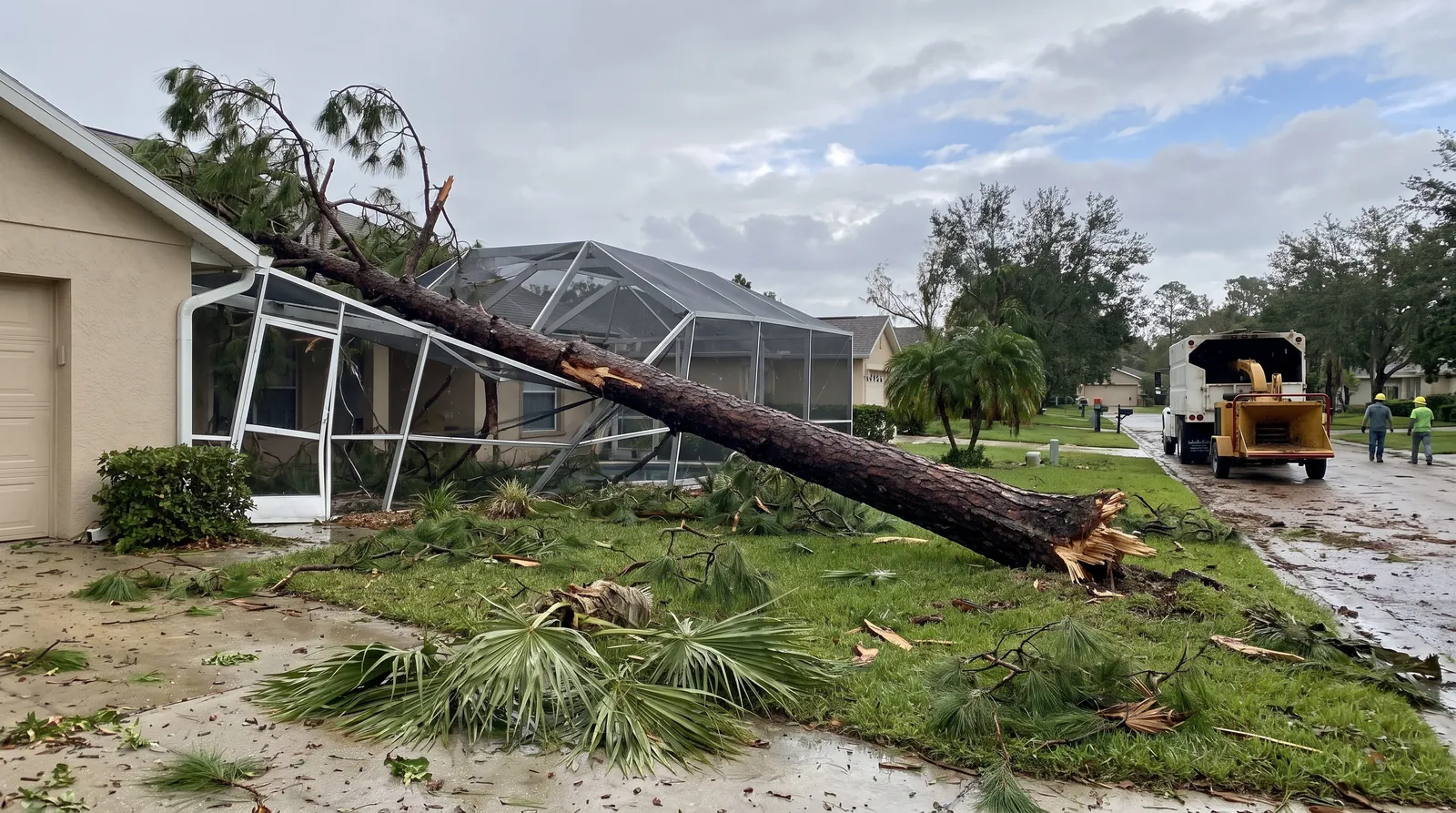
After each storm, the pattern in Palm Coast is the same. Laurel oaks and water oaks with internal decay lose limbs or split at the trunk. Slash pines, shallow-rooted on wet sand after a rainy summer, go over at the root plate — and they take a while, so a pine that survived the storm leaning is still a problem. Queen palms snap or lose their crowns. Anything that was topped in the past — hat-racked oaks with clusters of weakly attached sprouts — sheds those sprouts. Over-dense crowns act like sails. Live oaks, sabal palms and magnolias with sound trunks almost never fail, which is the University of Florida's finding as well as ours.
What actually helps
Thinning — removing selected whole limbs from the interior and edge of a dense crown so wind passes through instead of pushing. Reduction — shortening long limbs over the house back to a lateral branch so the lever arm is shorter. Deadwood removal — the dead limbs and hangers that are going to come down regardless. Cabling — a steel or synthetic cable between co-dominant stems in a V-crotch so it can't split. Removal of the trees that assessment says won't survive: hollow oaks, root-heaved pines, dead palms.
What makes it worse
Topping (cutting the top out of a tree to make it shorter) produces decay at every cut and weak sprouts that fail within a few years; Palm Coast prohibits it. Lion-tailing — stripping interior branches and leaving tufts at the tips — puts all the weight on the ends of the limbs. Hurricane-cutting palms — removing most of the fronds and leaving a few upright — starves the palm, weakens the crown and does nothing for wind. Removing more than about 25 percent of live canopy in a year on a mature tree stresses it.
When to do it
March through May. The trees are in leaf so dead wood is obvious, crews are available, and the work is done before June 1. Companies are booked solid by August; after a storm they're triaging.
A walk-through checklist
- Which oaks are laurel oaks, and how old? (See our ID guide.)
- Any cavities, fungus at the base, or dieback in the upper crown?
- Any tall pines within falling distance of the house, and are they leaning?
- Dead limbs or hangers over the roof, driveway, pool cage or play areas?
- Long limbs extended over the roof with no laterals to reduce to?
- Co-dominant stems with included bark (a tight V with bark folded in)?
- Palms with dead fronds, heavy seed pods, or a missing center spear?
- Has anything been topped in the past?
After the storm
Photograph everything before anyone cuts. Trees on structures come off first, then blocked driveways, then yard debris staged at the curb to Flagler County's specifications for FEMA pickup. Leaning trees that didn't fall are the ones to have looked at next — a pine at 15 degrees with a lifted root plate isn't going to straighten up.
Common questions
Should I trim my palms before a hurricane?
Remove dead fronds, boots and seed pods, and leave every green frond. Palms shed wind naturally with a full crown; a hurricane cut weakens them.
Will thinning my oak make it safer?
Yes, when done properly — selective removal of whole limbs, no more than about 15 percent of live canopy on a mature tree. It lets wind through and reduces sail.
Should I remove all the pines near my house?
Not automatically. Healthy pines with room and no lean often ride storms out; pines with lifted root plates, beetle damage, or a lean toward the house should go.
How much does hurricane prep cost?
Most Palm Coast lots are fully prepared for $1,200 to $4,500, depending on how many large oaks are near the house. The walk-through is free with the work.
Does insurance require it?
Increasingly, carriers ask for tree maintenance near the home at renewal and can non-renew over a big tree on the roof. A dated assessment and pruning record helps.
Related: Hurricane preparation service · Emergency tree service · Laurel oak vs live oak · Insurance guide