Why it matters
Two oaks dominate Palm Coast yards. The live oak (Quercus virginiana) is the sprawling, moss-hung tree of Southern postcards: dense wood, low wide crown, wind-resistant, and a lifespan measured in centuries. The laurel oak (Quercus laurifolia, sometimes sold as water oak's cousin or "Darlington oak") grows twice as fast, looks similar for its first twenty years, and was the developer's default tree in the 1970s and '80s. It lives 50 to 70 years, decays from the inside out as it ages, and fails — a limb, then a leader, then the whole tree — with little warning. Most of the big oaks failing in Palm Coast's original sections right now are laurel oaks reaching the end of their lives on schedule.
How to tell them apart
| Feature | Live oak | Laurel oak |
|---|---|---|
| Shape | Broad, low, spreading — often wider than tall | Upright, oval, taller than wide |
| Leaves | Small, thick, oval, dark green above, gray-fuzzy below; edges roll under | Longer, thinner, narrow (laurel-like); smooth below |
| Trunk | Short, massive, often forking low | Straight, taller, often fluted or buttressed at the base with age |
| Bark | Deeply furrowed, dark, blocky | Smoother, gray, shallower ridges |
| Leaf drop | Brief, in spring, as new leaves push | Heavier, late winter; more "deciduous" |
| Growth | Slow | Fast — 2–3 ft a year young |
| Lifespan | 200–300+ years | 50–70 years |
What to do with a laurel oak near the house
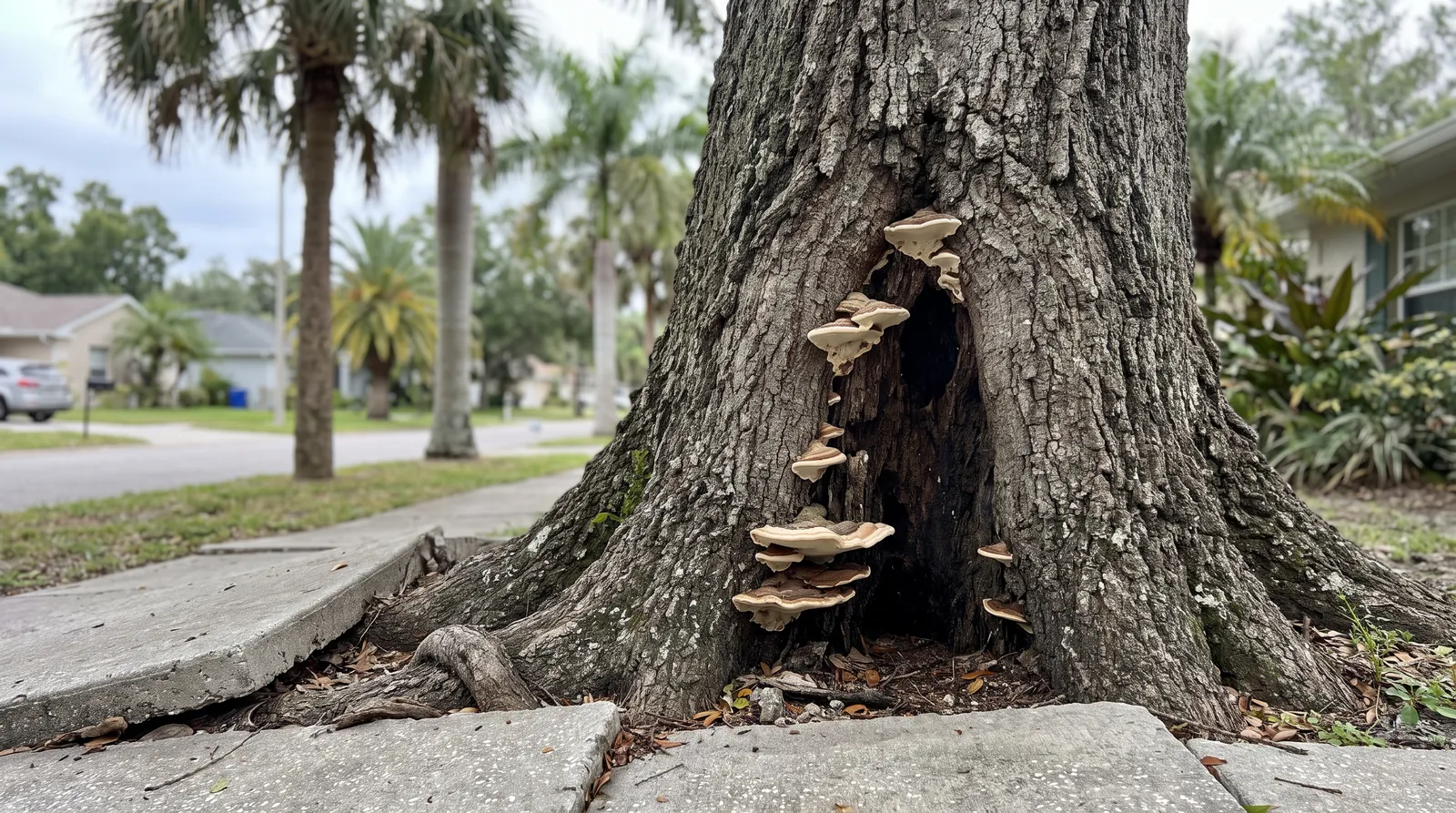
If it's under 40 years old and sound, prune it for structure and wind and enjoy it. If it's older, or shows any of these — a hollow or cavity you can put a hand in, shelf fungus or conks at the base, a fluted trunk with soft spots, dieback in the upper crown, large limbs dropping in calm weather — get an arborist assessment. Many of these trees qualify for removal without a permit under the 163.045 hazard-letter rule, and the right time to take one down is before it chooses its own moment in September.
What to do with a live oak
Keep it. A live oak near the house is one of the most wind-resistant trees in the Southeast and adds real value. Have the canopy lifted off the roof and thinned lightly every few years, remove dead wood, and never let anyone top it. The City of Palm Coast and the county treat live oaks as specimen trees, and removing a healthy one is both hard to permit and a mistake.
What to plant after a laurel oak comes out
A live oak, if there's room — or a Southern magnolia, a bald cypress, a winged elm, or a sabal palm for smaller spaces. Not another laurel oak, not a water oak, and not a queen palm next to the house.
Common questions
Is a water oak the same as a laurel oak?
Close cousins with the same problem — fast growth, short life, internal decay. Water oaks have spatula-shaped leaves and are even shorter-lived. Treat one near the house the same way.
My laurel oak looks healthy. Should I still remove it?
Not on age alone. A sound laurel oak with no cavities, fungus or dieback can be pruned and watched. When it starts showing decay, plan the removal on your schedule.
Can you tell which I have from a photo?
Usually, from a clear shot of the leaves and the trunk base. Text it to us — but the on-site look is free with any quote.
Do laurel oaks really fall in hurricanes more?
Yes. University of Florida's post-2004 surveys ranked laurel and water oaks among the least wind-resistant common trees in Florida, and live oaks among the most.
Related: Tree removal · Arborist services · Hurricane preparation · Permit rules